bodybendot
Showing posts with label Low vision. Show all posts

Not trying

Living with low vision I've to every time question myself (not yet the tea spoons. sigh!), if there is a real limitation to a task due to my low vision or if I am not doing anything to get out of my comfort zone? It is easy to deny everything because it is difficult to see. Living in denial is easy, doing something despite the visual challenge means hard work, dealing with your own ego on a daily-basis
(setting up an incompatible, overdemanding timer to every activity. "Calendar: Read 200 pages today." Start. Fail. Whine. Let despair out of its hiding place. Repeat again everyday. Never learn.).

A lot of limitations we impose on ourselves have no basis in reality. Sooner I eliminate these false limitations from my life, better relationship I will have with myself.

I've not used my camera for a long time. I liked watching people, their expressions, capturing the detail. When it started getting difficult, rather than finding a new technique/subject, I simply stopped to take my camera with me. I have charged the batteries and I am going to take it out. And I will try to find new ways of capturing things.  Try and unlearn the "normal" way and adapt to "my" way. Defenestrate the excuses. Create something, even if it means creating distortions. Who said there is just one way of seeing??



Read more »»  

ZoomReader app for iPhone 4

For iPhone users, AI Squared's ZoomReader allows to magnify and read the text in the captured image. You take a picture of the sign you want to read, it magnifies and retrieves the text from the image using OCR technology and reads it out to you. And it is just priced at $20.

Read more »»  

Kindle's Inaccessibility


I purchased a Kindle 3 a year ago. So far, the accessibility feature has been mostly adequate for me. Although text-to-speech and type face options depend on the publishers, which I find a huge issue. I always need to "try a sample" to ensure that I can "read" it!

After talking to some other people with low vision, I realised that Kindle still does not offer font option for page menu navigation. The Voice guide option (Menu - Settings - Page 2 first option) can help but it is not very reactive. By the time it reads out the contents, I am already squinting to find my way through on my own.

Still, I feel that e-ink does not strain my eyes if I read in enough light. When I purchased Kindle I could read easily in font size 5, now I rather choose font size 6. There are two more bigger font sizes that I can still choose.


I do not use text-to-speech option a lot, because the text-to-speech technology used in Kindle is still very basic. There is no pause between sentences which most of the times becomes very confusing.

Read more »»  

Reading books

Thanks to Kindle, I could again read in 2009 after a 5 year disturbing hiatus. My reading speed is still limited and I finish a book in 2 weeks rather than 2 days but I can READ.Yet, it remains a completely different experience.

For me, reading has never been an isolated activity. I have always associated a book with the external material circumstances linked with reading - the cover of the book, how I got the book (hours of rummaging through a library or a specific bookstore or gifted by a friend), outside weather, and my disposition as a reader at a given time and stage in my life.

Now, with a Kindle, there is no cover, no physical "form", no old pages, no more hunting through libraries (just search title on amazon and download with one click),

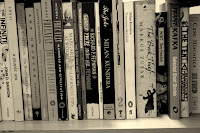
I sometimes grieve for the loss of material aspect of the book. Earlier, when I read paper books, each one had a separate physical identity with a different jacket, size, weight, each having a different odour and procuring a "physical" life of its own in my bookshelf (Samuel Beckett's "Molloy, Malone Dies, Unnamable" soaked in rain and then dried in sun, some pages of Othello's Arden edition smeared with my pink skin allergy...). It was not easy carrying Musil's The Man Without Qualities".

Now, on a Kindle everything is black and white, and customisable - font, spacing, pagination. To my annoyance, some books no longer retain their original author-intended page format and space appropriation vis-a-vis the written text. Where would we fit some of the works of Perec here, all the ambivalence between subjective and objective space?

Yet, I cannot complain. At least, an e-reader like Kindle allows me to "read" again despite low vision. And I shouldn't complain about physical form so much because I cannot read print anyways :P

I sometimes use text-to-speech option on Kindle for non-fiction books when I want to read in bus or in public. Partly to avoid reading in a moving bus or to avoid other people peaking into the page contents or sometimes to avoid a situation when strangers tell me that I shouldn't hold a book so close to my eyes. The narrator in Kindle's text-to-speech utility often ends up skipping essential pauses leading to misinterpretation and confusion. In comparison ZoomText narrator is much advanced. Although, I still find narrator or audio books too intrusive for a solitary activity (reading).

I am also these days a bit annoyed with my brain processing everything wrongly due to limited visual picture that it receives. I misread a lot without knowing that I'm misreading.

How do you manage prolonged reading with low vision? Do you have better solutions?

Read more »»  

To tell or not to tell

In my experience, most of the people don't care how difficult it maybe for you to live. We have all become insensitive to each other perhaps. And perhaps we all have our own set of woes to deal with on a daily basis. There is no space for others.

I've gone through phases in my life. When I was younger, people would think I fake it and they wouldn't believe I had a problem, because I was better at academics, my vision in the better eye was still 6/24 then. And usually there was never any problem with familiar places. I used to find it difficult to tell strangers (at fastfood counters or bakeries) that I cannot read the menu or tell the name of what I want. Five years back I had travelled for 30 days across Northern Europe alone with a zoom camera as my only aid. I didn't ask people for help then. 

Now I do not hesitate in telling people I've an eye problem and if they could help in reading out the menu, bus number, sign board etc. Although, I only talk about it if it is realy necessary. For e.g. at a department store, I prefer to be independent. I end up walking a lot if I am visiting a supermarket for the first time but once familiar I know where to pick what from. In case I need to buy a new product, I google the image to know what I need to look for. I'm really scared of cursive font and/or 20 page menus or the ones where the paper/font contrast is not good. In case I am not carrying magnifier, I ask them their best dishes out of starters/main course etc.


At Work

Personally, I feel you should never disclose completely about the progressive nature of your disability in a job interview or even later until you are sure that people will accept it and not create problems for you. You can state that you have low vision if you feel you would require your employer to purchase lowvisual aids for you (Screen magnifier/reader). If you can rely on windows accessibility, then you don't even need to mention low vision.

No one understands what it is to see like we see. Just like I can never fully fathom what kind of perception of the world a blind person has.

My teammates know that I've low vision and I use screen magnification (windows accessibility features). If I need to give a presentation to a client or internal staff, I prepare the slides in normal font but take printouts in large font for myself to present the slides. If other people are presenting, I ask them to provide me with large font printouts or email me their presentation before the meeting.

Recently I discussed in detail with someone from another team about my vision impairment. And this person thought that I should not be allowed to translate because I might misread and mistranslate something. I would have lost my job if this person had any authority to determine my eligibility for the role of a translator. I told him that our work is proofread before it is delivered and so far I've always had good feedback for my work and never any "misreadings" in the correction feedback tracker. I told him that I'm a proofreader as well still this person was not convinced that I should be fit for the job. 

Read more »»